For most of its history, Formula One has been a temple of precision, need for speed, and a very specific kind of corporate polish. But beneath its aerodynamic surface lies a surprisingly expressive tradition. Livery culture is as much about identity and art as it is about sponsors and sectors.
Before we had NFTs or sneaker drops, F1 had liveries which, to this day, deliver a narrative that goes beyond the basics of a paint job. Livery is the visual vocabulary that can tell you anything from who a car belongs to, what nation it represents, who paid for it or who designed it. Think of it as a uniform, a billboard, war paint, and a rare artwork all rolled into one.
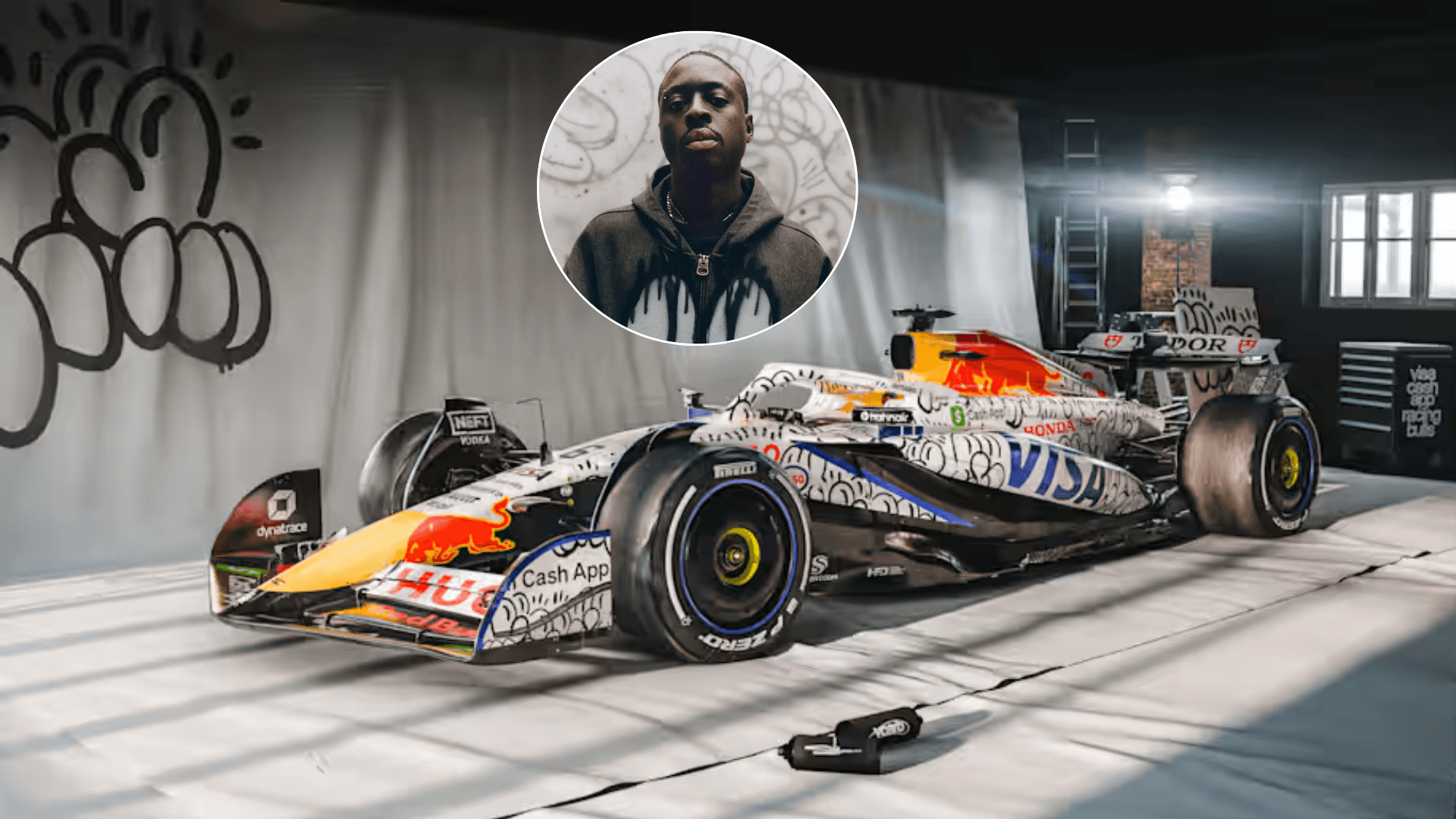
Today (6 July 2025) at the 2025 British Grand Prix, a new chapter was written on the tarmac. With a riotous spray of caricatured faces and curious eyeballs, the Visa Cash App Racing Bulls VCARB 02 car rolled out of the paddock bearing the unmistakable mark of Slawn, the 24 year old Nigerian artist and enfant terrible of the London art scene. Yes, Formula 1 officially has its first contemporary African art livery, and it’s as cool and culture-rich as the artist himself.

Let’s rewind a bit, because before Slawn tagged the VCARB 02 like it was a Brixton wall, F1 cars have gone through an equally colourful evolution worth racing through. From the stately to the spray-painted, the predictable to the radical we connect the dots backwards to illustrate why Slawn’s artwork entering the conversation marks a monumental cultural correction for the African continent.
F1 LIVERY: A BRIEF HISTORY IN SIX GEARS
Gear 1 | Pre-1968

For most of F1’s high-speed history, liveries were technical, tightly controlled and steeped in national pride. Cars repped their country, not brands. Think Britain’s Racing Green, France’s Blue and Italy’s Rosso Corsa (a racy red).
Gear 2 | 1968

In 1968, livery culture was hijacked by tobacco’s bulging budgets. Team Lotus shattered tradition as the first Formula One car to wear full commercial branding, swapping British Racing Green for Gold Leaf tobacco’s red and gold.
Gear 3 | 1993

As global culture reflects bolder artistic expressions, F1’s livery matched that evolution. Art took the driver’s seat when Ligier’s French GP car got a Hugo Pratt-designed livery, a surreal art detour before logos took over again.
Gear 4 | 2006 – 2020s

Let’s call this the uniform era. Grid-wide conformity ruled, unless you were Red Bull, liveries were predictable and brand-deep with logos practically covering all car surface areas.
Gear 5 | 2023 – 2024

Art gets back on the track when Alfa Romeo and McLaren flirt with pop-up artist collabs. In 2023 Zandvoort got graffiti with Swiss-German graffiti artist BOOGIE’s one-off Alfa Romeo livery. 2024 saw Japan get dragons when McLaren invited calligraphy artist MILTZ to design a special livery which featured hand-drawn Edo-style dragons and swirling clouds.
Gear 6 | 2025

Global culture has been demanding more authentic and unmitigated expressions, making way for the first contemporary African artist to design a Formula 1 car livery. Slawn brings his Lagos-meets-London bravado to Silverstone via Racing Bulls.
WHO IS THIS WILDCARD IN THE WIND TUNNEL?

Olaolu Akeredolu-Ale, aka Slawn, doesn’t do subtle. His art is a brash collision of abstraction, satire, and caricature, featuring spray-painted works that pulse with his intersectional identity and youthful irreverence. A proud son of Yoruba heritage, Slawn was raised between Nigeria and the UK. He first picked up a brush during the COVID lockdown and in just a few years, has become one of Britain’s most in-demand visual artists, bridging subcultures and the soft power of art with a confidence few artists his age (24) can match.
He paints with both irony and intimacy. Whether he’s defacing fashion silhouettes (meant in the most ironically flattering sense) or designing trophies, his aesthetic refuses containment. In 2023, he became the youngest artist ever to design the BRIT Award statuette. He’s since been tapped by icons like SZA, Beyoncé, and A$AP Rocky, as well as the Emirates FA Cup and now, the high temples of F1. His East London café, Beau Beau’s, doubles as a cultural hub, feeding both food and fire to London’s art scene.
WHY THIS MILESTONE MATTERS
With his fingerprints now on one of Formula One’s most visually audacious liveries, Slawn is reminding the world that African artistry is as directional as it is decorative. He shows that contemporary African art isn’t confined to adornment, but is also potent in steering global tastes, setting a creative agenda and commanding where design is headed.
For a sport long defined by European tradition and Western brand identity, the presence of a Nigerian-born artist spray-painting Yoruba-rooted symbolism across a Formula 1 car rightfully fills decades-long gaps. The inclusion of diverse cultures now better reflects the dynamic mix of global audiences who enjoy the sport.

Ntokozo Maseko has never been one to wait her turn. At 25, she became the youngest editor in the history of South Africa’s heritage title BONA, steering the four-language magazine into the digital era and winning the title a Thetha Masombuka Award for linguistic excellence along the way. Named one of the Mail & Guardian’s Top 200 Young South Africans, she has since built a 17-year career shaping the voice of iconic brands across luxury, lifestyle, and culture.
Her editorial eye has graced various mastheads; from a legacy print title, an innovative digital magazine to a pan African luxury platform. Today, as inaugural Editor-in-Chief of Robb Report Africa, Ntokozo curates a world where African excellence meets global luxury, telling the stories of the continent’s most remarkable people, places, and creations with precision, wit, and unapologetic style.