The South African born, Swiss-based artist guides us through The Big Five, a limited edition art book highlighting his traditional animal oil paintings dramatically brought to life through a novel type of AI adaptation developed at his studio in Zurich.
Deep, deep in the depths of eastern Botswana and the Northern Tuli Block, a bright eyed South African lioness plops aside a scrappy knobthorn bush. Her whisker spot pattern, the signature used to track her pride, presents in clear view as she studies the landscape for a late lunch in the vast Mashatu Game Reserve. About thirty meters above on a sunbleached branch, a handsome sharp-eyed peregrine falcon perches, brows furrowed and claws clenched tightly. Unannounced, chaotic activity in front demands the attention of both.
An unlikely protagonist, a portly young elephant joyfully waddles into a shallow mudhole, a welcome respite for his steamy leathery skin in the forty degree heat. A light cloud of silver blue flies gravitates from the mud as the beast playfully flails his weight to and fro. But wait, within the shade of the nearby vegetation, two more spectators draw toward the spectacle. A muscular African leopard crouches discreetly in the brush shade and, with all the commotion, a short distance behind her, a sleepy lowland baboon moves closer from the canopy. The tension builds.
The wild tableau of the five inhabitants is the South Africa artist Conor Mccreedy knows best. With the November global launch of Mccreedy’s The Big Five, a limited edition silk bound volume of only one hundred copies, the book pairs his AI enhanced painting process with a dynamic QR code journey.
The Big Five is Alive
The Big Five release signals a shift in how these animals are encountered, carrying them from painted stillness into motion through the AI system Mccreedy developed in Zurich. What begins in oil extends into a new form, rebuilt through technology that studies each stroke and animates it with exacting detail. It is the next step in a practice that bridges his early South African existence with the technology precision of his Zurich studio.
Mccreedy is the first artist to bring classical oil painting into direct conversation with AI, using it not as a shortcut but as a tool to examine and rearticulate his brushwork. In Switzerland, he and a small team train systems that read the structure of his strokes and translate them into movement, producing animated counterparts that carry the same weight and intention as the originals. They are not reinterpretations. They are extensions.
“The new AI layer allows my painted figures to transcend the canvas and take on new life. With this technology, I can create a multisensory experience for collectors that invites viewers to reflect and dream,” notes Mccreedy.
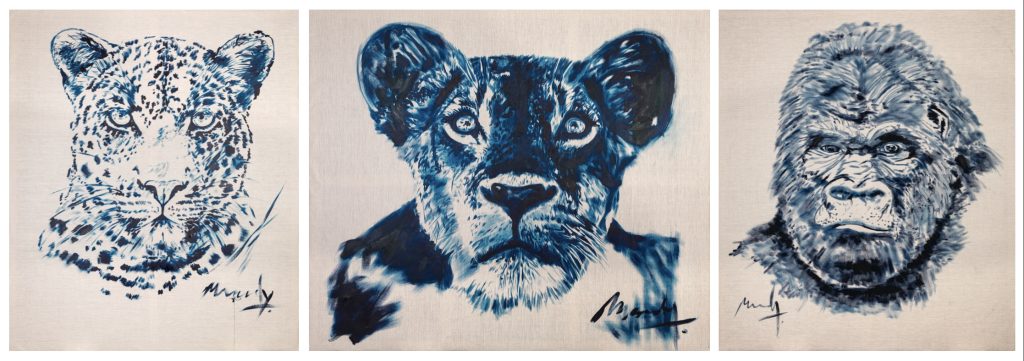
Bringing Canvas and Book Pages to Life
The Big Five presents the works he has awakened through this process, including pieces from his Roman Emperors series recently shown at the Archaeological Museum of Capri. Each animation produced is singular, created within a vertically integrated system that marks the first instance of traditional oil paintings being transformed into animations while retaining every brushstroke.
To protect that singularity, each ultra high definition animation is certified through the Origyn Foundation, ensuring authenticity, privacy and data integrity. Because each piece exists only once, it carries the exclusivity of a physical artwork, and its resolution is refined enough to project onto building scale surfaces without losing depth or clarity. His collectors now receive both the physical painting and its digital counterpart, each verified through biometric based certification and supported by embedded chips that secure its authenticity.
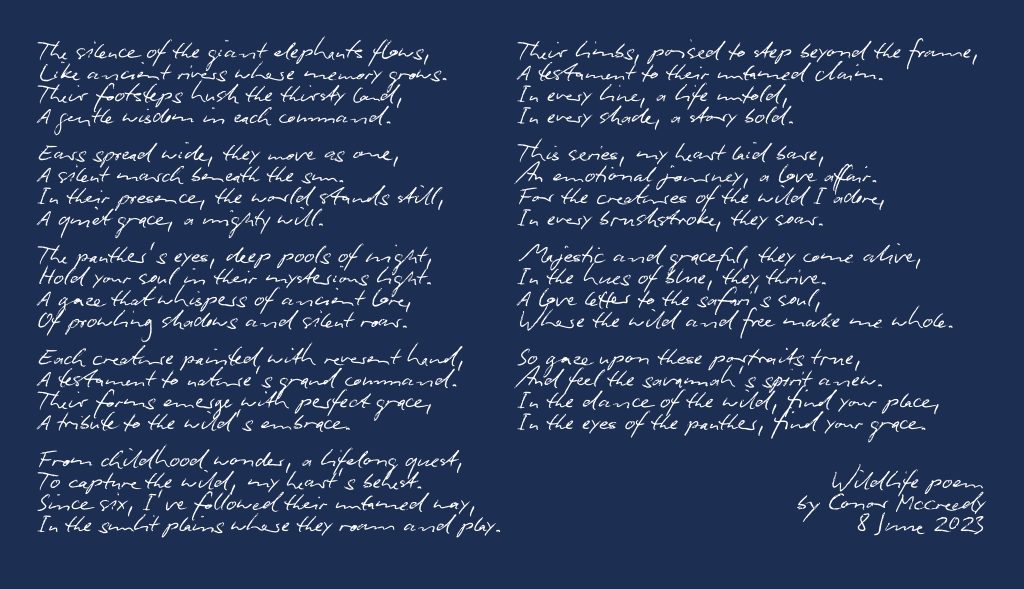
The Animals Never Stop Moving
As the sun sets back on the plain, the landscape falls into the same cadence Mccreedy experienced growing up in South Africa. As the lioness drifts back toward the river line, the lanner falcon tucks his wings and repositions to a lower perch. The elephant grazes along the edge of the shore before settling on a secure spot for night’s fall. The African panther checks the shifting breeze with a short stroll through the brush as the baboon gathers a few leaves before settling into the canopy.
The evening surge of motion dissolves, and the five animals return to the terrain that shaped them long before they appeared on canvas or in code.