Tudor has chosen a poetic moment to expand its repertoire. Just ahead of the Mid-Autumn Festival, when the moon is at its most luminous, the brand unveiled the 1926 Luna, its first watch to feature a moon phase complication. It is a gesture that connects horology to heritage, folding a celestial rhythm into a collection designed to represent the essence of Tudor’s philosophy: beauty, reliability and value in equal measure.
The decision to introduce a moon phase in the 1926 line is telling. This collection, named for the year Hans Wilsdorf registered the Tudor name, has always been the most grounded in the brand’s roots. It offers an unembellished platform where Tudor shows what it does best: well-made, versatile watches that carry the elegance of Swiss craftsmanship without pretence. By placing the moon phase here, the brand demonstrates a certain restraint. Rather than launching the complication in one of its bolder sport models, Tudor chose a canvas defined by clarity and proportion. The Luna is therefore an innovation carried with subtlety, a way of expanding the 1926’s character while staying true to its understated nature.
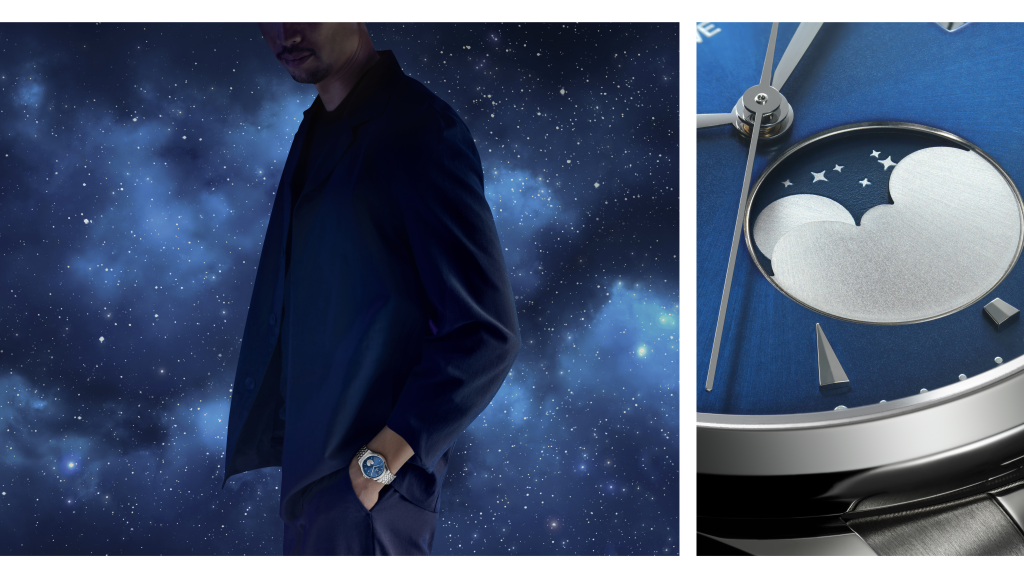
The watch itself is balanced, with a 39 millimetre steel case polished to a mirror finish, a domed sapphire crystal that softens the light across the dial, and a moon phase indicator at six o’clock. Available in black, blue, or a champagne dial conceived with musician and actor Jay Chou, each variation plays the complication differently. Chou, known across Asia as the “King of Mandopop” and recognised globally for his work in film, fashion and art, has been a long-time Tudor ambassador. His involvement adds a layer of cultural weight, and his champagne dial design offers the most theatrical detail: a gold disc of moonlight emerging through a dark aperture, waxing and waning with the lunar cycle. It is a small drama that gives the watch both presence and charm.
What keeps the Luna firmly in Tudor territory is the way this flourish is contained by familiar design codes. The domed dials, marked with applied Arabic numerals and arrow-shaped hour markers, are lifted from vintage models in the brand’s history. Sword hands match the dial tones, maintaining clarity. Even the seven-link bracelet, alternating between satin-brushed and polished finishes, reflects Tudor’s longstanding devotion to bracelets that are as functional as they are refined. On the wrist, the Luna wears with the same quiet confidence that has always made the 1926 line a discreet choice for daily use.
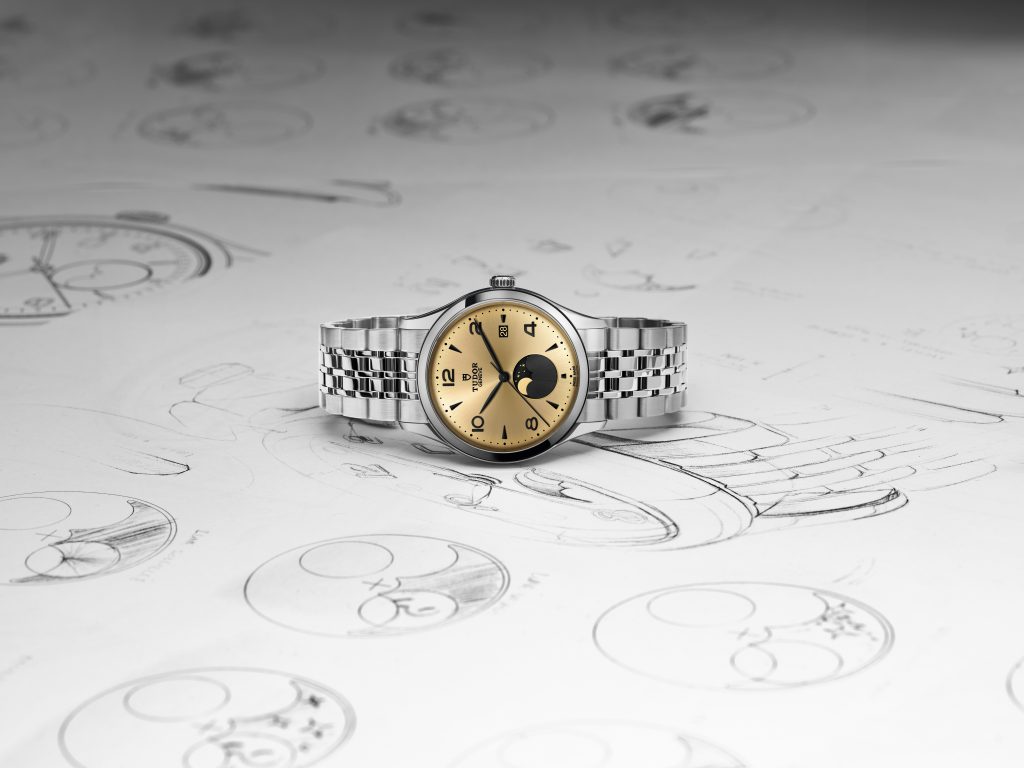
Inside, the self-winding Calibre T607-9 keeps time with chronometer precision while tracking the 29.5-day lunar cycle. Its reliability sits comfortably alongside the watch’s practical qualities, such as 100 metres of water resistance, a reminder that Tudor’s complications are designed for living, not for the safe. It is this blend of sturdiness and lyricism that separates Tudor from rivals who might treat a moon phase as decoration alone.
The 1926 Luna is not a flamboyant statement. It does not seek to reposition the brand or dazzle with complexity. Instead, it demonstrates that taste in luxury can be as much about restraint as it is about expression. To wear this watch is to enjoy the quiet pleasure of a complication that marks time on both a human and celestial scale, housed in a case built for everyday life. Tudor has not so much reinvented itself as it has extended an idea: that beauty, value and reliability can coexist with poetry. For a brand whose motto is Born to Dare, the daring move here is subtlety.
The Tudor 1926 Luna is priced just below $3000 (R50 200.00 in South Africa). Go to tudorwatch.com for more information.